Monday, November 16, 2009

Trouble in the Slow Lane

If you have your doubts about bike lanes, you're not alone. Segregated bike lanes, a marked off area that was formerly known as a gutter; as we're all too familiar with here in the states, or a cycle path, seen more in Europe, are real threats to safety. If bicycles really have all the rights any other vehicle has (yes, a bike is a vehicle, according to U.S. law), then why do they need to be segregated from traffic? There isn't a semi truck lane or a motorcycle lane, so why a bike lane?

Sticking to your guns? Well, then you probably already have your answer: Speed. It's a valid problem, but segregation of vehicles can create many more problems than it solves, primarily at intersections (of course).

Now, the point of this entry is really just to question the design assumptions bike lanes impose, and it's time to provide reasons why vehicles of all race and creed should live and move as one. I'm going to make an effort to make these explanations brief -- they are pretty obvious when you consider them.

Issue 1: Obstructed cycle lanes. Consider this scenario: a delivery truck needs to stop, and there are not any parking spaces available. Where does that truck park? That's right, the segregated bike lane. These drivers have become used to doing this, and it is perfectly legal, if in a properly zoned area -- unless there is a bike lane. Now there are two problems, trucks with nowhere to stop and cyclists with nowhere to escape, because motorists could care less that your path is obstructed.

Issue 2: Maintenance. Have you ever noticed that the dirtiest part of the road is at its edges? We all have, and there is good reason for it. Cars produce a sweeping effect as they travel -- they move a lot of air. This sweeping moves all kinds of debris, including puncture inducing glass and metal shards, right into cycle lanes that are most often located along the outside of roads. This problem is helped if sweeping equipment is regularly dispatched alone these routes -- wait doesn't that create a lane obstruction? Additionally, not all cycle lanes are accessible by street sweepers, either. If there wasn't a bike lane, no one would be traveling in these hazards.

Issue 3: Increased risk of collisions. Cycle paths in urban settings with many interchanges result in more car-bicycle collisions. It's a fact. What's so unintuitive about that? Segregation imposes more cognitive tasks for both riders and drivers. Having all vehicle traffic together is simple -- literally. To drive (or ride) this point home, I will leave you with a few quotes from the article cited above:
In the United States,[40] UK,[41] Germany, Sweden,[42] Denmark[43]and Finland,[44] it has been found that cycling on roadside urban cycle tracks/sidepaths results in up to 12-fold increases in the rate of car/bicycle collisions. At a 1990 European conference on cycling, the term Russian roulette was used to describe the use of roadside cycle paths.
That's a 1200 percent increase in car-bicycle collisions!
In Helsinki, research has shown that cyclists are safer cycling on roads with traffic than when using the city's 800 kilometres (500 mi) of cycle paths.[46] The Berlin police and Senate conducted studies which led to a similar conclusion in the 1980s.[47] In Berlin 10% of the roads have cycle paths, but these produce 75% of fatalities and serious injuries among cyclists.[48] In the English town of Milton Keynes it has been shown that cyclists using the off-road Milton Keynes redway system have on a per-journey basis a significantly higher rate of fatal car-bicycle collisions than cyclists on ordinary roads.[41] Cycle lanes and bike lanes are less dangerous than cycle paths in urban situations but even well-implemented examples have been associated with 10% increases in casualty rates.
Hopefully I need say no more. Bike lanes. Bad idea. Stop it!

Photo credit: Wikipedia.org

Vehicular Cycling

Gear up for another bicycle related post -- no pun intended.

Have you ever braved traffic on a bike? It's a pretty polarizing experience. Usually you love it or you find it terrifying, but, as I have seen as friends come to terms with their traffic fears, it really isn't so bad once you know how to ride: like a car.

You may think that this seems to fly in the face of the ever more prevalent implementation of bike lanes that seem to be popping up in urban places. You're right it does. As drivers get accustomed to bike lanes, more and more of them seem to believe that that is the only legal space a cyclist should occupy -- far from the truth!

I wonder how many of these drivers have considered something they do many times a day: a left turn. For a cyclist bound to a bike lane, usually found on the right, it can be a chore. How are you to cross lanes of traffic, that now believe you have no right to leave your gutter ghetto, to reach a left turn lane -- or worse, wait for a chance to turn with traffic (hopefully) waiting behind you when no turn lane is present? Is the solution really to turn right and then make a U-turn?

There are all kinds of design problems in road infrastructure when it comes to facilitating dissimilarity paced vehicles, but I have come to find that by practicing vehicular cycling (read: ride like a car), many of these problems are mitigated, if not almost completely resolved.

Now I'm not saying you should be reckless -- far from it. Drivers know what to expect from cars around them, and by showing drivers you're following the same rules they are, they know exactly what to expect from you too.

If you are interested in more information of vehicular cycling, please read more at the VC Wikipedia entry
.

Media Blacklist Edition 2: Alexandra Smith - Cycle Path Scandalmonger

Another edition of "Media Blacklist" is here already, and will continue the established theme: bicyclists' rights.

This time I find myself gawking as Alexandra Smith of The Sydney Morning Herald perpetuates my previously found false myth, stating that cyclist are freeloading off of non-cycling citizens' tax dollars.

I'll leave you to read all the facts and figures in her article for yourself, but the brunt of the matter is that governments are really trying to be more environmentally responsible in their transportation infrastructure development decisions. Now, keeping in mind that sooner than later cars won't really be an environmental problem, as hydrogen cars come to prevalence, it is still important to provide ways for communities to exercise while commuting, during time that would otherwise be wasted.

Back to the meat of the issue, I might be comparing apples to oranges, but if Australia's local street budget is anything like ours here in the states, then the 70 million being spent in Sydney is small potatoes considering the billions spent on local street infrastructure annually. I think it's high time that the cyclists of the world are rewarded some back taxes for subsidizing auto traffic for so long through paying the same taxes motorists do that pay for 88.6% of local streets that is accounted by 2004 this study.

One loose end, her argument that these new lanes are taking up vital space is a valid one, in my opinion. I really don't understand the need for cycle lanes in speed zones under 40 mph -- I honestly regret the installment of bike lanes on some of my regular routes. I really will get around to explaining that soon. In any event, the bottom line is the dollar sign and there is almost always more space to be had.

Photo credit: smh.com.au

New York City Bicycle Safety Campaign: "Look"

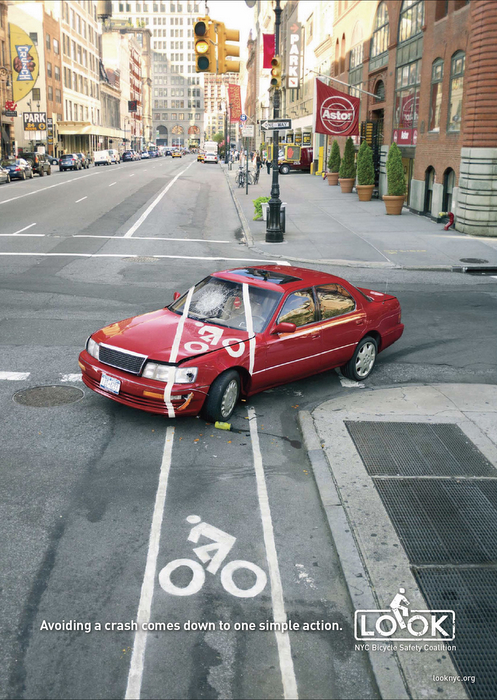
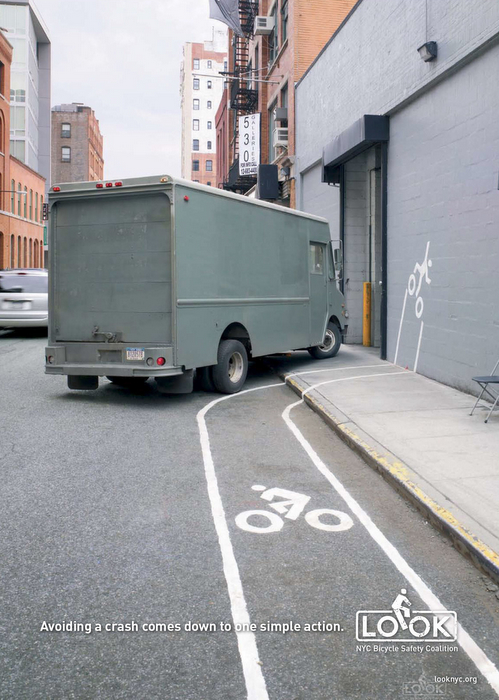
Take a look at these posters for a minute:


Without getting into my personal opposition to bike lanes, and my strong preference to practice vehicular cycling when appropriate (both of which I might just have to cover in another entry), I really thought these public service adverts by a NYC campaign Look were clever and timely given the increased number of bicycle commuters there, and increasingly across the nation.

It might be fair to say that these posters make light of a very real and serious problem that both cyclists and motorists face, but I really think these are elegantly subtle reminders for bike commuters to think defensively and to expect the unexpected.

The design of these posters is also quite inspirational to me. I try and keep an eye out for this kind of third-level meaning potential in everyday life, and I must say that this is a great example of just that. By painting cycling lanes places where they usually aren't, it tells a whole story to the observer that isn't altogether explicit or obvious. But, once you do get it, it's a very clear narrative that has a strong message that was communicated by imagery alone.

Media Blacklist Edition 1: Terence Corcoran - Bicycle Bigot


Who's really getting a free ride, cyclists or motorists?

Take a look at Terence Corcoran's article. He is an editor for Canada's National Post, and, with the national scope of his argument aside, has some very strong opinions about taxing cyclists that are just plain ignorant.

I will let this bigot speak for himself:
But bike riders pay nothing, even though the cost of urban bicycle infrastructure, operating risks and potential liabilities are mounting. Bikers are getting a free ride that all non-bikers are paying for.
This is just not true! Some might believe that because cyclists are not paying fuel taxes and licensing fees, they are not paying for roads, but it should be argued that cyclists actually subsidize the cost of roads for drivers. If you're still not sure that Corcoran is sorely mistaken, if not an altogether discreditable liar, I challenge you to take his next claim seriously.
And then there's the carbon footprint. When car drivers cruise Yonge Street on Saturday night, their metabolisms are more or less flat-lined. They just sit there, burning up little energy personally but paying for the cost of their automobile's carbon footprint via taxes and fees. Bike riders grinding up the same route burn up a lot more carbohydrates, which their bodies convert into carbon dioxide and exhale, adding to their carbon footprint. The volumes are small, but it all adds up, and bicyclists don't pay.
Wow! That's right, a breathing tax. Why not tax every man, woman, and child to deal with the carbon emissions they produce by breathing? Corcoran may not see a reason not to.

Back on track, James D. Schwartz, a writer for The Urban Country helped me find a 2004 study by the Victoria Transport Policy Institute that found that those who do not operate a car full-time or at all, including cyclists, do actually subsidize drivers.
Since bicycling and walking impose lower roadway costs than motorized modes,
people who rely primarily on nonmotorized modes tend to overpay their fair
share of roadway costs and subsidize motorists.

Since most cycling and walking happens on local roads, we are not going to worry about highway funding. With this in mind, in the 2002 the U.S. spent $27.9 billion dollars on local roads, but only $3.1 billion was sourced through user fees, leaving $24.8 billion paid by general taxes that are paid by drivers, cyclists, and everyone else alike.

Now, considering the higher demands cars put on our road infrastructure, including increased wear and the need for much more space to allow the same number of people transport -- just to name a couple key examples. Who is really paying more for their fair share of the road? You might find it shocking, but cyclists are.

So I say to Mr. Terence Corcoran, maybe you should be paying those who use alternate forms of transportation -- those who are subsidizing the cost of driving your automobile -- instead of slathering on unfounded bias, and encouraging motorists to continue disrespecting bicyclist's right to the road.

Learning that some media authorities are plainly contrived liars can be hard to stomach. Hopefully future editions of "Media Blacklist" will help soften that blow.

Photo credit: greenpeace.org

Wednesday, November 4, 2009

Medical Acoustics Lung Flute


This strange looking device offers a great solution for the 10 million Americans who suffer from chronic obstructive pulmonary disease. Instead of relying on medications and strenuous coughing to help clear up unhealthy amounts of mucus in their lungs, now they can vibrate it out with the Lung Flute. The Lung Flute, which is close to receiving its FDA approval, was created by
Sandy Hawkins and provides 16-hertz vibration in the user's torso just by blowing air through it.

Hawkins had been trying to make a device to produce these vibrations for years, but he couldn't come up with one that was portable, inexpensive, and human-powered until he took a big step back and thought about different existing ways to create vibrations and remembered the reed of woodwind instruments. What I walk away with was this, if what your doing isn't working, then try and think of something else that does the same thing in another application. Inspiration is all around us.

Image source: popsci.com

Tuesday, November 3, 2009

Unexpected Word Art


A web developer for Fujinon Binoculars has hidden an unexpected image in the source code of their website. The image is the outline of Mt. Fuji as viewed from the Fujinon headquarters, and it's an amazingly creative little Easter egg for anyone who take a look at the HTML.

It reminds me that everything can be more expressive than you might expect, and thinking about doing things differently can yield fascinating results.

Source: geeksaresexy.net